Rapid Prototyping Manufacturing
Rapid prototyping manufacturing is often associated with speed. While accelerated development remains an important benefit, its greater value lies in helping engineering teams validate designs, reduce manufacturing risk, and improve production readiness before tooling and production begin.
Successful products rarely move directly from concept to manufacturing without refinement. Material behavior, dimensional variation, assembly interactions, and production repeatability all influence whether a design performs consistently outside controlled testing environments. Rapid prototyping provides the opportunity to identify and resolve these challenges while engineering changes remain practical and cost-effective.
This guide explains how rapid prototyping manufacturing supports engineering validation, prototype CNC machining, material evaluation, precision prototyping machining, and production readiness within a connected Production Lifecycle. It also explores how engineering collaboration, dimensional control, and manufacturing stability help organizations build greater production confidence before scale magnifies failure.
The key shift: Rapid prototyping is no longer just an early development activity. It has become a strategic engineering process that helps organizations bridge the gap between concept development and stable, repeatable manufacturing.
From Prototype Success to Production Confidence
A prototype performs exactly as intended.
Dimensions meet the specification.
Assembly proceeds without issue.
Functional testing confirms the design.
Engineering approval is granted, and the project moves forward with confidence.
Then production begins.
Components that fit together during validation begin exhibiting dimensional variation. Material behavior changes under repeated manufacturing cycles. Assembly tolerances become increasingly difficult to maintain. Tooling modifications introduce unexpected delays. Additional validation becomes necessary, extending development schedules while increasing engineering costs.
These challenges are common throughout product development because a successful prototype does not automatically indicate that a design is ready for manufacturing.
Rapid prototyping manufacturing is often viewed primarily as a method for quickly producing prototype parts. In practice, its greatest value extends much further. When integrated into a structured engineering process, rapid prototyping becomes a decision-making framework that helps organizations evaluate manufacturability, improve engineering collaboration, reduce production risk, and strengthen production readiness before manufacturing begins.
This distinction is becoming increasingly important as product complexity continues to grow. Modern engineering programs require more than fast prototype delivery. They require validation processes that accurately predict manufacturing performance across multiple production stages.
Rather than treating prototyping as an isolated milestone, many organizations now integrate rapid prototyping throughout the Production Lifecycle. This ensures that engineering decisions remain aligned with manufacturing realities from concept development through production launch.
For organizations evaluating prototyping services or rapid prototyping companies, the question is no longer simply how quickly a prototype can be produced. The more important question is how effectively the prototype contributes to production confidence, manufacturing stability, and long-term product success.
What Is Rapid Prototyping Manufacturing?
Quick Answer
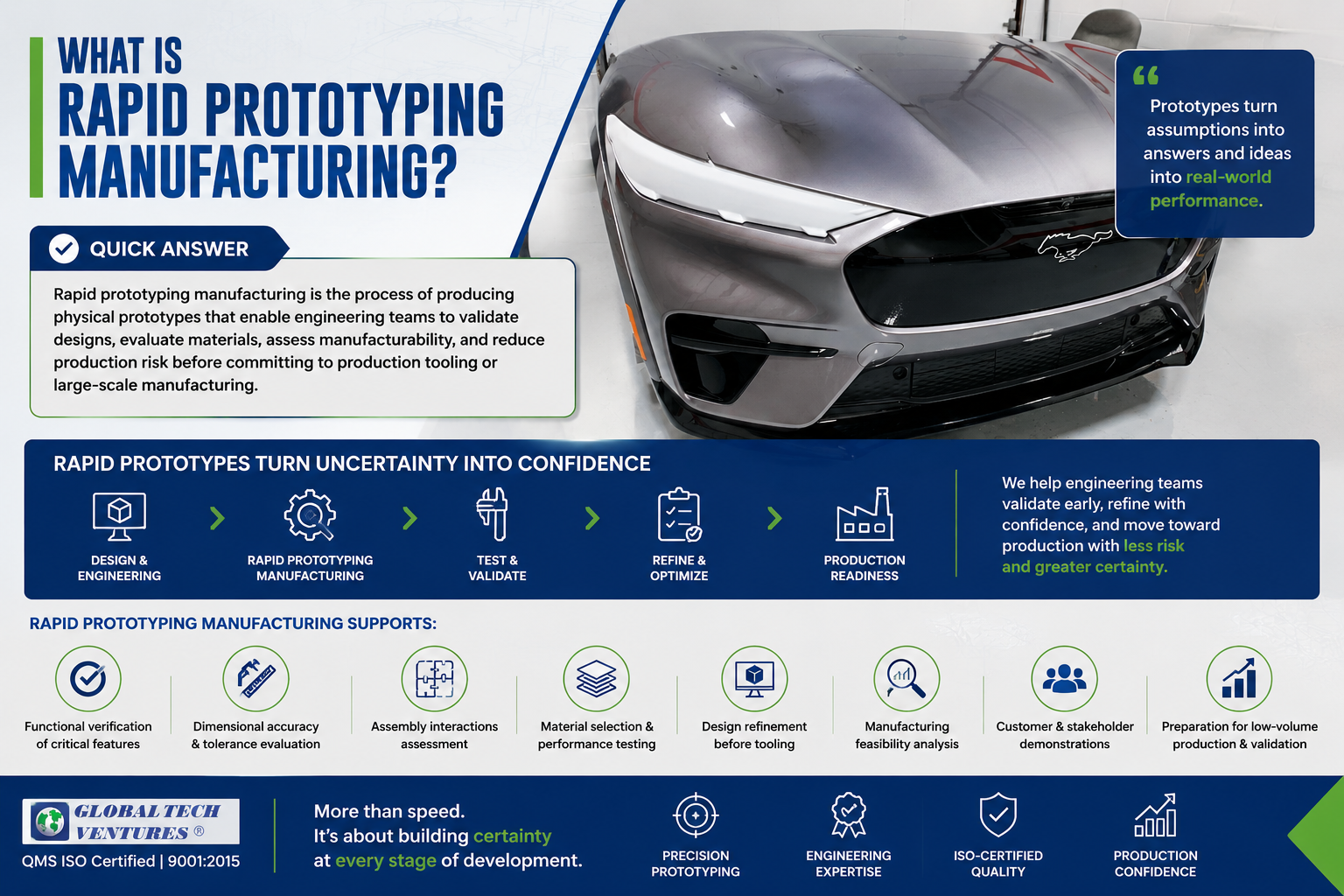
Rapid prototyping manufacturing is the process of producing physical prototypes that enable engineering teams to validate designs, evaluate materials, assess manufacturability, and reduce production risk before committing to production tooling or large-scale manufacturing.
Rapid prototyping manufacturing is frequently described as a method for producing parts quickly. While speed remains valuable, that definition captures only a small portion of its contribution to modern product development.
The true purpose of rapid prototyping is to reduce uncertainty.
Every engineering program begins with assumptions. Computer models predict performance. Material specifications estimate behavior. Tolerance analyses forecast assembly outcomes. Manufacturing plans anticipate production capabilities.
Rapid prototypes provide the first opportunity to compare those assumptions against physical reality.
By producing functional components early in development, engineering teams can evaluate how designs behave under realistic conditions while modifications remain practical and comparatively inexpensive.
Depending on project requirements, rapid prototyping manufacturing may support several objectives, including:
- Functional verification of critical features
- Evaluation of dimensional accuracy and tolerance performance
- Assessment of assembly interactions between multiple components
- Material selection and performance testing
- Design refinement before production tooling
- Manufacturing feasibility analysis
- Customer demonstrations and stakeholder reviews
- Preparation for low-volume production and production validation
Different projects require different prototype objectives. A cosmetic housing intended for ergonomic evaluation may prioritize appearance and fit, while a structural aerospace component may demand production-grade materials, precision prototyping, machining, and extensive dimensional verification.
Because of these varying objectives, successful prototyping services are rarely defined by a single manufacturing technology. Instead, they combine engineering expertise, process selection, material knowledge, and validation planning to ensure that each prototype yields information that improves downstream manufacturing decisions.
Viewed through this perspective, rapid prototyping manufacturing becomes far more than an accelerated production method. It becomes a structured engineering discipline that helps organizations reduce development uncertainty while building a stronger foundation for production readiness.
Rapid Prototyping Is One Phase of the Production Lifecycle
Quick Answer
Rapid prototyping is not an isolated manufacturing process. It is a critical phase within the Production Lifecycle that helps engineering teams validate designs, evaluate manufacturing feasibility, reduce production risk, and prepare products for repeatable manufacturing.
Many discussions surrounding rapid prototyping focus on technologies such as CNC machining, additive manufacturing, or vacuum forming. While each process serves an important purpose, concentrating solely on fabrication methods overlooks the larger objective.
The purpose of rapid prototyping manufacturing is not simply to create a physical part.
Its purpose is to generate engineering knowledge that supports better manufacturing decisions.
Every prototype answers important questions about the product being developed.
- Can the design be manufactured consistently?
- Will selected materials perform under expected operating conditions?
- Do tolerances remain stable during assembly?
- Can manufacturing processes support repeatable production?
- Will production tooling introduce new constraints?
These questions influence every stage that follows.
Instead of viewing prototyping as a separate engineering activity, many organizations now approach it as one component within an integrated Production Lifecycle that connects design, validation, manufacturing planning, and production readiness.
The Production Lifecycle Framework
Concept Development
Engineering Validation
Rapid Prototyping
Design for Manufacturability (DFM)
Prototype CNC Machining & Process Validation
Tooling & Fixtures
Low-Volume Production
Production Readiness
Manufacturing Stability
Production Confidence
Each phase builds upon information gathered during the previous stage.
Concept development establishes functional objectives.
Engineering validation confirms whether the design performs as intended.
Rapid prototyping transforms digital concepts into physical components that can be evaluated under realistic conditions.
Design for Manufacturability introduces manufacturing considerations while engineering changes remain manageable.
Prototype CNC machining and complementary manufacturing processes provide the dimensional accuracy needed for functional testing, assembly evaluation, and process refinement.
Tooling and fixture development begin translating validated designs into repeatable manufacturing systems.
Low-volume production exposes variability that often remains hidden during early prototype builds, allowing engineering teams to strengthen process stability before production volumes increase.
Production readiness is achieved when design, manufacturing, materials, tooling, and validation work together as an integrated system that supports repeatable manufacturing performance.
Ultimately, manufacturing stability and production confidence are not achieved during a single stage. They are the cumulative result of informed engineering decisions made throughout the entire Production Lifecycle.
Understanding rapid prototyping within this broader framework changes how organizations evaluate prototype companies. Instead of selecting providers based solely on equipment capabilities or turnaround times, engineering teams increasingly seek partners capable of supporting validation, manufacturing planning, dimensional control, and lifecycle governance from concept through production.
Why Engineering Teams Use Rapid Prototyping Manufacturing
Quick Answer
Engineering teams use rapid prototyping manufacturing to validate designs, reduce development uncertainty, evaluate manufacturing feasibility, improve engineering collaboration, and strengthen production readiness before investing in production tooling.
Product development rarely follows a perfectly predictable path. Initial concepts evolve as testing uncovers new information, manufacturing constraints influence design decisions, and functional requirements become more clearly defined. The earlier these discoveries occur, the easier they are to address.
This is why rapid prototyping manufacturing has become an integral part of modern engineering programs. Rather than relying exclusively on computer models or theoretical analysis, engineering teams create physical prototypes that provide measurable insight into how a product performs under realistic conditions.
The objective extends well beyond producing a sample component. Every prototype should contribute knowledge that improves downstream engineering and manufacturing decisions.
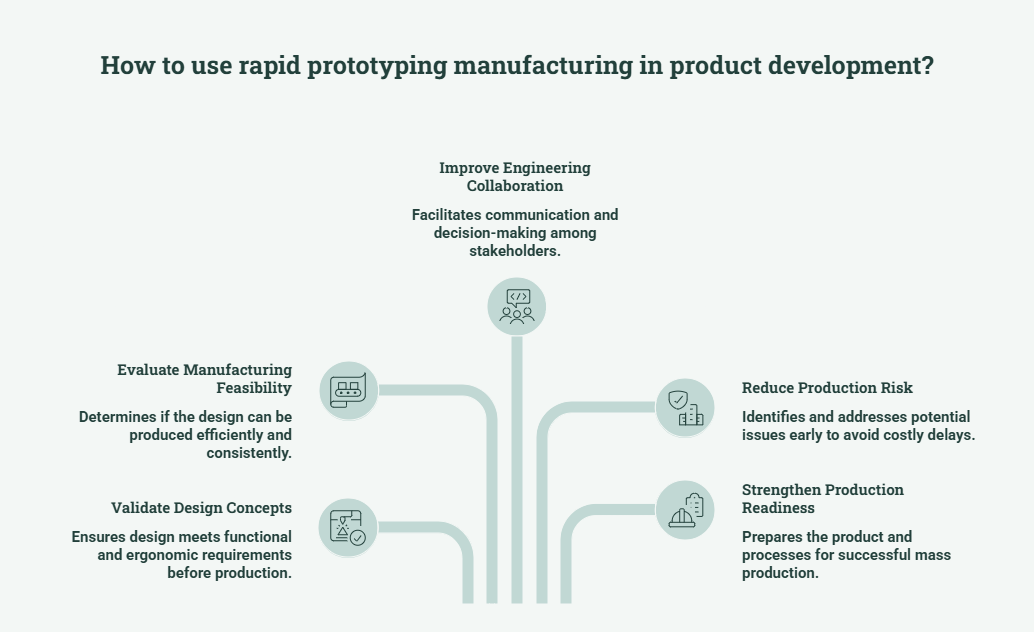
Organizations typically use rapid prototyping manufacturing to support several critical objectives.
Validate Design Concepts
Engineering models provide valuable information during development, but physical prototypes often reveal challenges that digital simulations cannot fully predict.
Creating a prototype allows teams to evaluate component interaction, ergonomics, functionality, accessibility, and overall design intent before committing significant resources to production tooling.
Early validation helps identify design improvements while engineering modifications remain manageable.
Evaluate Manufacturing Feasibility
A design that functions well during development may still present manufacturing challenges.
Features that appear practical within a CAD model may prove difficult to machine, assemble, inspect, or produce consistently at higher volumes.
Rapid prototyping helps engineering teams determine whether manufacturing processes can support the intended design while maintaining quality and repeatability.
This early evaluation reduces the likelihood of significant redesign during later production stages.
Improve Engineering Collaboration
Successful product development depends upon effective communication between engineering, manufacturing, quality, procurement, and program management teams.
Rapid prototypes create a common reference point, allowing every stakeholder to evaluate the same physical component rather than relying solely on technical drawings or digital models.
Questions regarding manufacturability, assembly, inspection, material selection, and production planning can often be resolved more efficiently when supported by physical validation.
This collaborative approach reduces assumptions while improving decision quality throughout the development process.
Reduce Production Risk
Every unresolved design issue carries forward into the next stage of development.
Small dimensional inconsistencies become assembly challenges.
Material uncertainty becomes performance variability.
Manufacturing assumptions become production delays.
Rapid prototyping helps expose these risks before they become increasingly expensive to resolve.
Instead of reacting to manufacturing problems after tooling is complete, engineering teams can address them while design flexibility remains high.
Strengthen Production Readiness
One of the greatest advantages of rapid prototyping manufacturing is its ability to prepare products for successful production.
Each prototype contributes valuable information regarding:
- Manufacturing processes
- Material performance
- Assembly methods
- Inspection requirements
- Tolerance capability
- Process repeatability
Collectively, this information helps engineering teams transition from prototype validation toward production readiness with greater confidence.
When rapid prototyping is viewed as a continuous learning process rather than a single project milestone, it becomes a powerful contributor to manufacturing stability across the entire Production Lifecycle.
Engineering Validation: Turning Prototype Success into Manufacturing Confidence
Quick Answer
Engineering validation confirms more than whether a prototype functions correctly. It evaluates whether a design can consistently meet manufacturing, assembly, quality, and performance requirements under real production conditions.
Many engineering programs successfully validate prototype functionality yet still experience unexpected production challenges.
This occurs because functional testing alone rarely reflects the complexity of manufacturing.
A prototype may demonstrate excellent performance during controlled evaluation while simultaneously containing characteristics that introduce instability during production.
Engineering validation should therefore extend beyond confirming that a design works. It should determine whether the design can be manufactured repeatedly while maintaining consistent quality and performance.
Modern validation programs typically address several interconnected areas.
Functional Validation
Functional validation confirms that the prototype performs its intended purpose.
Depending on the application, this may include:
- Mechanical operation
- Structural performance
- Thermal behavior
- Electrical functionality
- Environmental testing
- User interaction
While essential, functional validation represents only one component of production readiness.
Dimensional Validation
A component may satisfy functional requirements while still exhibiting dimensional characteristics that create manufacturing challenges.
Engineering teams evaluate:
- Critical dimensions
- Geometric tolerances
- Feature alignment
- Surface finish
- Machining consistency
- Inspection repeatability
Precision prototyping and machining often play an important role during this stage because accurate prototype components provide greater confidence in evaluating dimensional performance.
Assembly Validation
Individual parts rarely operate independently.
Most products consist of multiple components that must be assembled consistently under production conditions.
Assembly validation examines:
- Part interaction
- Fastener accessibility
- Alignment accuracy
- Clearance requirements
- Assembly sequence
- Serviceability
Many production issues originate during assembly rather than during component manufacturing.
Evaluating assemblies early helps reduce downstream integration challenges.
Material Validation
Material selection influences far more than structural performance.
Engineering teams also evaluate:
- Thermal expansion
- Wear resistance
- Chemical compatibility
- Environmental durability
- Surface characteristics
- Manufacturing behavior
Prototype materials that closely represent production materials generally provide more meaningful validation data.
Selecting appropriate materials during prototyping helps improve confidence in future manufacturing performance.
Manufacturing Validation
Perhaps the most overlooked aspect of engineering validation is determining whether the manufacturing process itself can consistently produce acceptable parts.
Questions often include:
- Can dimensional accuracy be maintained across multiple builds?
- Does the selected manufacturing process support repeatability?
- Are inspection methods capable of consistently verifying quality?
- Can production variation remain within acceptable limits?
These considerations help transform prototype validation into manufacturing confidence.
Organizations that address manufacturing capability during engineering validation often experience smoother transitions into tooling, low-volume production, and full-scale manufacturing.
Prototype CNC Machining: When Precision Matters Most
Quick Answer
Prototype CNC machining produces highly accurate functional prototypes using production-grade materials, making it one of the most effective methods for validating fit, function, tolerances, and manufacturability before production begins.
Not every prototype requires the same manufacturing process.
Concept models intended for visual evaluation may be produced using additive manufacturing, while functional engineering components often require tighter tolerances, superior surface finishes, and production-grade materials.
Prototype CNC machining is frequently selected when engineering teams require prototypes that closely represent the characteristics of finished production components.
Unlike processes that primarily support conceptual evaluation, CNC machining removes material from solid stock using computer-controlled equipment to produce complex geometries with exceptional dimensional accuracy.
This makes prototype CNC machining particularly valuable when engineering decisions depend upon precise measurements and functional testing.
Functional Prototype Testing
Many products cannot be adequately evaluated using simplified prototype models.
Applications involving mechanical assemblies, sealing surfaces, structural interfaces, or moving components often require prototypes manufactured from production-intent materials.
Prototype CNC machining enables engineering teams to validate:
- Functional performance
- Mechanical fit
- Structural integrity
- Surface finish
- Component interaction
- Assembly performance
Because the manufacturing process closely resembles production machining, validation results often provide greater confidence when planning future manufacturing activities.
Dimensional Accuracy and Repeatability
Engineering validation depends upon accurate information.
Even minor dimensional variation can influence assembly performance, inspection results, and manufacturing planning.
Precision prototyping machining provides engineering teams with prototype components that enable detailed dimensional analysis and reduce uncertainty during validation.
This accuracy becomes particularly important when prototypes are used to evaluate:
- Critical tolerances
- Mating components
- Precision assemblies
- Tooling interfaces
- Production fixtures
Reliable dimensional data supports better engineering decisions throughout the Production Lifecycle.
Supporting Production-Intent Materials
One of the primary advantages of prototype CNC machining services is the ability to machine many of the same materials intended for production.
Common materials include:
- Aluminum
- Stainless steel
- ABS
- Polycarbonate
- Acetal (Delrin)
- Nylon
- PEEK
- Acrylic
Using production-grade materials allows engineering teams to evaluate machining behavior, structural performance, thermal response, and assembly characteristics under conditions that more closely resemble final manufacturing.
Material validation performed during prototyping helps reduce uncertainty before production tooling is commissioned.
CNC Machining Within the Production Lifecycle
Prototype CNC machining should not be viewed solely as a machining service.
Within the broader Production Lifecycle, it provides critical engineering data that supports:
- Design refinement
- Engineering validation
- Dimensional control
- Manufacturing planning
- Tooling decisions
- Low-volume production preparation
When integrated into a structured validation process, prototype CNC machining helps bridge the gap between digital design and repeatable manufacturing, improving production readiness while reducing the likelihood of costly engineering changes later in the program.
Selecting Materials That Support Prototype Validation
Quick Answer
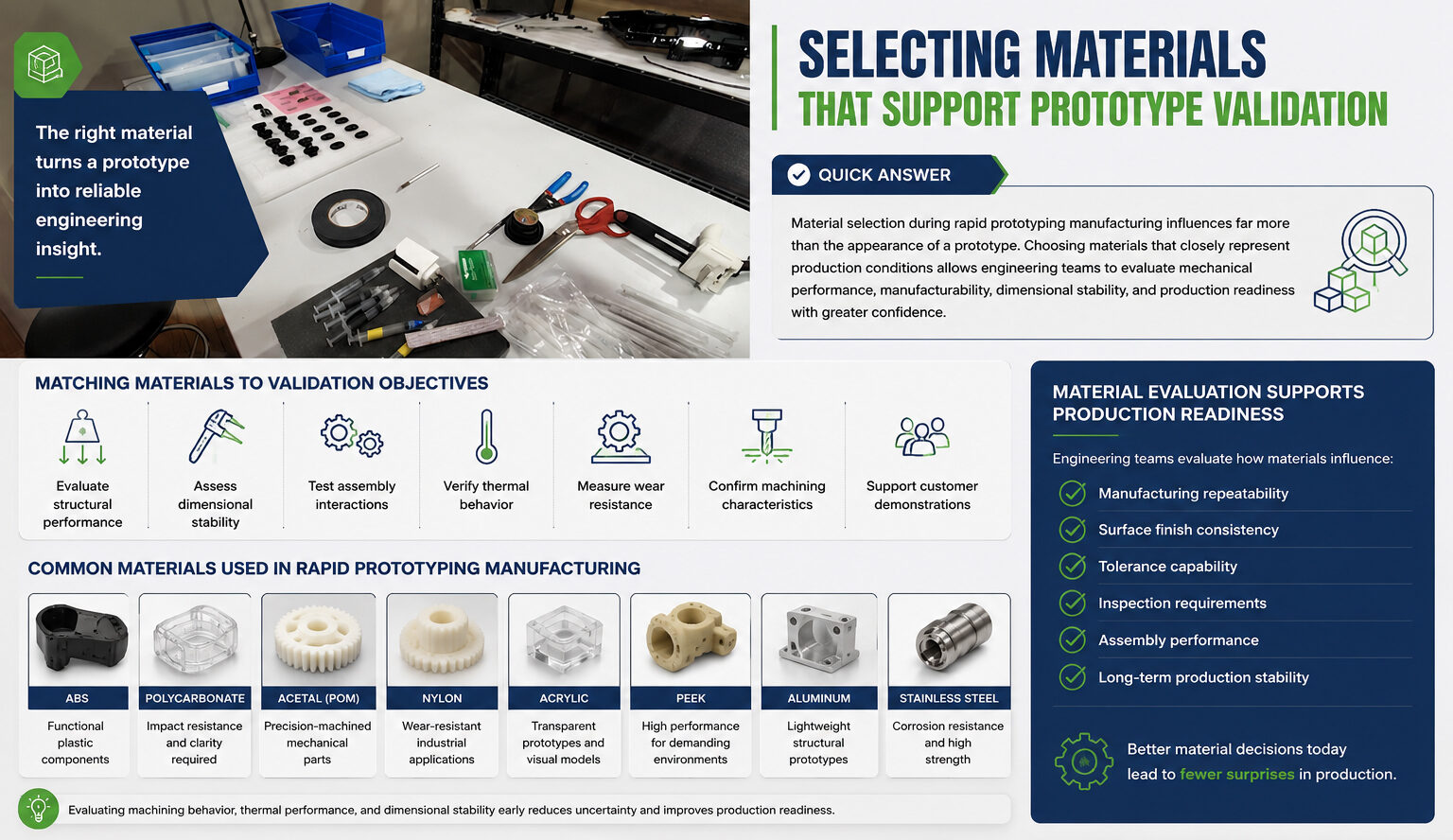
Material selection during rapid prototyping manufacturing influences far more than the appearance of a prototype. Choosing materials that closely represent production conditions allows engineering teams to evaluate mechanical performance, manufacturability, dimensional stability, and production readiness with greater confidence.
A prototype is only as valuable as the information it provides.
If the selected material behaves differently from the production material, engineering decisions based on prototype testing may not accurately predict manufacturing performance. A design that appears successful during validation can encounter unexpected issues once production materials, manufacturing methods, or operating conditions change.
For this reason, material selection should always align with the prototype’s objectives.
Some projects require cosmetic evaluation. Others focus on structural performance, thermal stability, chemical resistance, or dimensional accuracy. Understanding these objectives helps engineering teams select materials that produce meaningful validation results.
Matching Materials to Validation Objectives
Different stages of product development often require different material characteristics.
During early concept development, engineering teams may prioritize materials that allow rapid iteration and design refinement. As development progresses, prototype materials typically move closer to production-intent specifications to improve validation accuracy.
Common validation objectives include:
- Evaluating structural performance
- Assessing dimensional stability
- Testing assembly interactions
- Verifying thermal behavior
- Measuring wear resistance
- Confirming machining characteristics
- Supporting customer demonstrations
Selecting materials based on these objectives helps ensure that every prototype contributes useful engineering knowledge rather than simply confirming appearance.
Common Materials Used in Rapid Prototyping Manufacturing
Depending on the application, rapid prototyping manufacturing may involve a wide range of engineering plastics and metals.
Frequently used materials include:
- ABS for functional plastic components
- Polycarbonate where impact resistance is important
- Acetal for precision-machined mechanical parts
- Nylon for wear-resistant applications
- Acrylic for transparent components
- PEEK for demanding engineering environments
- Aluminum for lightweight structural prototypes
- Stainless steel is used where corrosion resistance and strength are required
Each material exhibits distinct machining characteristics, thermal behavior, and manufacturing considerations. Evaluating these characteristics during prototyping helps reduce uncertainty before production begins.
Material Evaluation Supports Production Readiness
Material selection should not end once a prototype functions correctly.
Engineering teams also evaluate how materials influence:
- Manufacturing repeatability
- Surface finish consistency
- Tolerance capability
- Inspection requirements
- Assembly performance
- Long-term production stability
When these factors are considered early, prototype validation becomes more representative of real manufacturing conditions, improving confidence as projects progress toward tooling and low-volume production.
Rapid Prototyping and DFM: Why Design Decisions Matter Early
Quick Answer
Design for Manufacturability (DFM) helps engineering teams identify manufacturing challenges during development rather than after production tooling is completed. Integrating DFM into rapid prototyping reduces redesign, improves repeatability, and strengthens production readiness.
Many production challenges originate long before manufacturing begins.
Features that appear practical during product design may require complex machining operations, difficult assembly procedures, or expensive tooling modifications once production planning begins. These issues are rarely the result of poor engineering. More often, they occur because manufacturing considerations were introduced too late in the development process.
Rapid prototyping manufacturing creates an ideal opportunity to evaluate manufacturability while design flexibility remains high.
Designing for Repeatable Manufacturing
A design that functions successfully as a single prototype may still present significant production challenges.
Engineering teams evaluate questions such as:
- Can the geometry be manufactured consistently?
- Are tolerances achievable during production?
- Will machining operations remain efficient?
- Can inspection verify critical dimensions reliably?
- Does the design simplify assembly?
Answering these questions early helps reduce engineering changes later in the program.
Integrating DFM into Prototype Development
Rather than treating Design for Manufacturability as a separate activity, many organizations integrate DFM throughout the prototype development process.
This collaborative approach allows engineering and manufacturing teams to evaluate:
- Feature accessibility
- Machining strategies
- Material utilization
- Tool accessibility
- Inspection methods
- Assembly requirements
- Production scalability
The result is a design that performs not only during validation but also throughout manufacturing.
DFM Reduces Production Risk
Every engineering change made after tooling has begun becomes progressively more expensive.
Minor modifications may require:
- Tool redesign
- Fixture adjustments
- Additional validation
- Supplier coordination
- Production delays
Applying DFM principles during rapid prototyping helps identify these opportunities before they affect schedules and budgets.
Instead of reacting to manufacturing constraints, engineering teams proactively design products that support repeatable, efficient production.
Tooling Decisions Should Begin Before Production
Quick Answer
Tooling decisions should begin during prototype development, not after design approval. Early tooling planning helps engineering teams reduce manufacturing risk, improve dimensional control, and strengthen production readiness before production volumes increase.
Tooling is often viewed as the point where product development transitions into manufacturing.
In reality, successful tooling strategies begin much earlier.
Information gathered during rapid prototyping and manufacturing directly influences tooling design, fixture development, inspection methods, and production planning. Delaying these considerations until after prototype approval often increases both engineering complexity and manufacturing risk.
Prototype Validation Informs Tooling Strategy
Engineering teams use prototype data to evaluate whether tooling can support:
- Critical tolerances
- Surface finish requirements
- Assembly repeatability
- Production cycle times
- Inspection accessibility
- Material behavior
The more accurately prototype validation reflects production conditions, the more effectively tooling can support long-term manufacturing objectives.
Fixtures Improve Manufacturing Consistency
Fixtures play an important role in maintaining dimensional accuracy during machining, assembly, and inspection.
Early fixture planning helps engineering teams improve:
- Part location accuracy
- Repeatable machining
- Inspection consistency
- Assembly alignment
- Production efficiency
Considering fixtures during prototype development often reduces the need for extensive modifications once production begins.
Tooling Supports Manufacturing Stability
Production tooling should do more than produce acceptable parts.
It should contribute to a manufacturing process that delivers consistent quality across repeated production runs.
When tooling decisions are informed by engineering validation, dimensional analysis, and production-focused prototyping, organizations are better positioned to achieve manufacturing stability while minimizing costly late-stage engineering changes.
Low-Volume Production Bridges Validation and Manufacturing
Low-volume production provides the first opportunity to evaluate manufacturing performance under realistic operating conditions. It helps engineering teams verify repeatability, refine production processes, and strengthen production readiness before full-scale manufacturing begins.
Many organizations view prototype completion as the final step before production.
However, the transition from prototype validation to high-volume manufacturing often introduces challenges that are difficult to identify early in development.
Low-volume production helps bridge this gap.
Rather than producing a single prototype, engineering teams manufacture multiple production-intent components using processes that more closely resemble future manufacturing operations.
This stage provides valuable insight into how products, materials, tooling, and manufacturing systems perform under repeatable conditions.
Evaluating Manufacturing Repeatability
A prototype may perform perfectly during initial testing.
The more important question is whether that performance can be reproduced consistently.
Low-volume production allows engineering teams to evaluate:
- Dimensional consistency across multiple parts
- Process variation
- Material consistency
- Assembly repeatability
- Inspection capability
- Operator interaction
These observations provide valuable information before manufacturing volumes increase.
Refining Production Processes
Low-volume production also supports continuous process improvement.
Engineering teams may identify opportunities to optimize:
- Machining strategies
- Tool selection
- Fixture design
- Inspection procedures
- Assembly workflows
- Quality documentation
Making these refinements before full production begins reduces downstream disruption while improving manufacturing efficiency.
Building Production Confidence
The objective of low-volume production is not simply to manufacture additional parts.
Its purpose is to confirm that the complete manufacturing system can consistently deliver products that meet engineering expectations.
When combined with engineering validation, DFM, prototype CNC machining, and structured tooling development, low-volume production becomes one of the strongest indicators of production readiness.
Rather than representing the end of prototype development, it serves as the final stage in which engineering knowledge is transformed into manufacturing confidence before production scales up.
Production Readiness Begins with Connected Engineering Decisions
Quick Answer
Production readiness is achieved when engineering validation, manufacturing planning, material selection, tooling strategy, and quality processes work together to support consistent, repeatable production. It is built throughout the Production Lifecycle rather than at the point manufacturing begins.
Production readiness is often misunderstood as the stage immediately before manufacturing. In practice, it begins much earlier.
Every engineering decision influences how successfully a product transitions into production. Material selection affects machining performance. Tolerance strategies influence assembly consistency. Validation determines whether manufacturing challenges are identified before tooling investments are made.
When these activities occur independently, risk accumulates across the development process. Engineering teams may approve a design that performs well during testing but remains difficult to manufacture consistently.
Production readiness is built by connecting each stage of the Production Lifecycle rather than treating them as isolated milestones.
Organizations that achieve stronger production outcomes typically focus on:
- Engineering validation that reflects manufacturing conditions
- Material selection aligned with production objectives
- Design for Manufacturability (DFM) during prototype development
- Prototype CNC machining for dimensional verification
- Low-volume production to confirm repeatability
- Documented quality processes that support consistent execution
This connected approach reduces uncertainty before production begins while helping engineering and manufacturing teams make informed decisions with greater confidence.
Rather than asking whether a prototype works, production-ready organizations ask whether the product, process, materials, tooling, and manufacturing system can perform consistently throughout the entire production lifecycle.
Choosing the Right Rapid Prototyping Partner
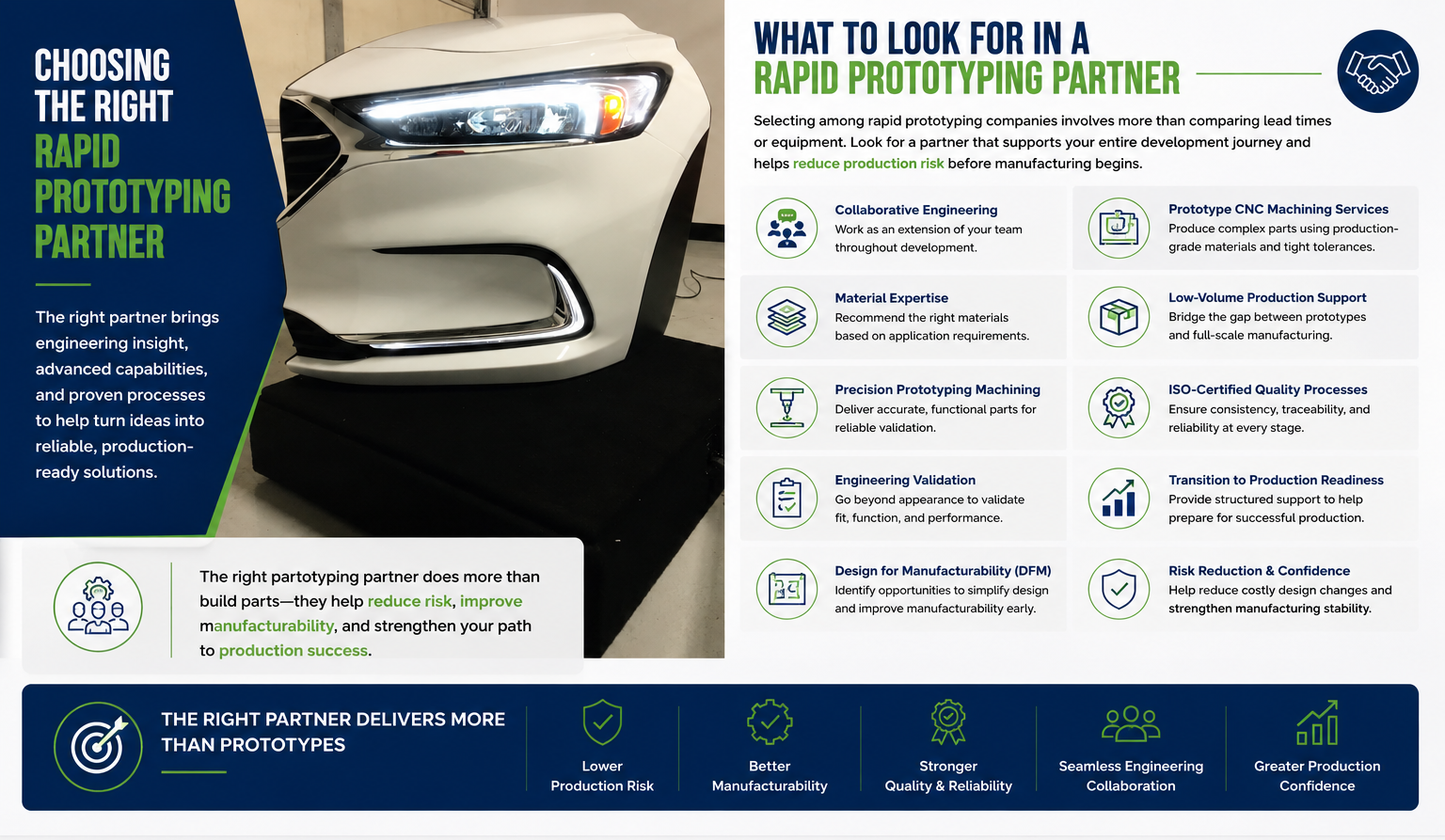
Selecting among rapid prototyping companies involves much more than comparing lead times or available equipment.
An effective partner contributes engineering insight throughout product development while helping reduce production risk before manufacturing begins.
When evaluating prototype companies or prototyping services, engineering teams should consider whether the provider can support:
- Collaborative engineering throughout development
- Material selection based on application requirements
- Precision prototyping machining for functional validation
- Engineering validation beyond cosmetic prototypes
- Design for Manufacturability discussions
- Prototype CNC machining services using production-grade materials
- Low-volume production support
- ISO-certified quality processes
- A structured transition toward production readiness
Providers that combine these capabilities contribute more than prototype fabrication. They become engineering partners that help organizations improve manufacturing stability, strengthen production confidence, and reduce costly design changes later in the development process.
Building Production Confidence with Global Technology Ventures Inc. (GTV)
Rapid prototyping manufacturing delivers its greatest value when it forms part of a connected engineering strategy rather than an isolated manufacturing service.
Global Technology Ventures Inc. (GTV) approaches product development through the broader Production Lifecycle, integrating concept development, engineering validation, rapid prototyping, CNC machining of prototypes, tooling considerations, and low-volume production into a coordinated process that supports production readiness.
By integrating engineering collaboration, precision prototyping, machining, material expertise, dimensional control, and ISO-certified quality systems, GTV helps organizations reduce manufacturing uncertainty before production begins.
Rather than focusing solely on producing prototype parts, the objective is to generate engineering knowledge that improves manufacturing decisions, enhances repeatability, and supports long-term production stability.
Whether developing a new product, refining an existing design, or preparing for low-volume manufacturing, engineering teams benefit from validation processes that accurately reflect manufacturing reality.
As products become increasingly complex and development timelines continue to compress, organizations that connect engineering decisions across the Production Lifecycle are better positioned to reduce production risk, improve manufacturing stability, and move forward with greater confidence in production.
If the goal extends beyond building a prototype to building a product that can be manufactured consistently and confidently, Global Technology Ventures Inc. (GTV) provides the engineering collaboration and lifecycle support needed to help bridge that transition.
Move beyond prototype development and build confidence in production with every engineering decision. Contact Global Technology Ventures Inc. (GTV) today or request a quote to learn how our integrated approach to rapid prototyping, manufacturing, engineering validation, and Production Lifecycle support can help reduce risk and prepare your product for successful manufacturing.