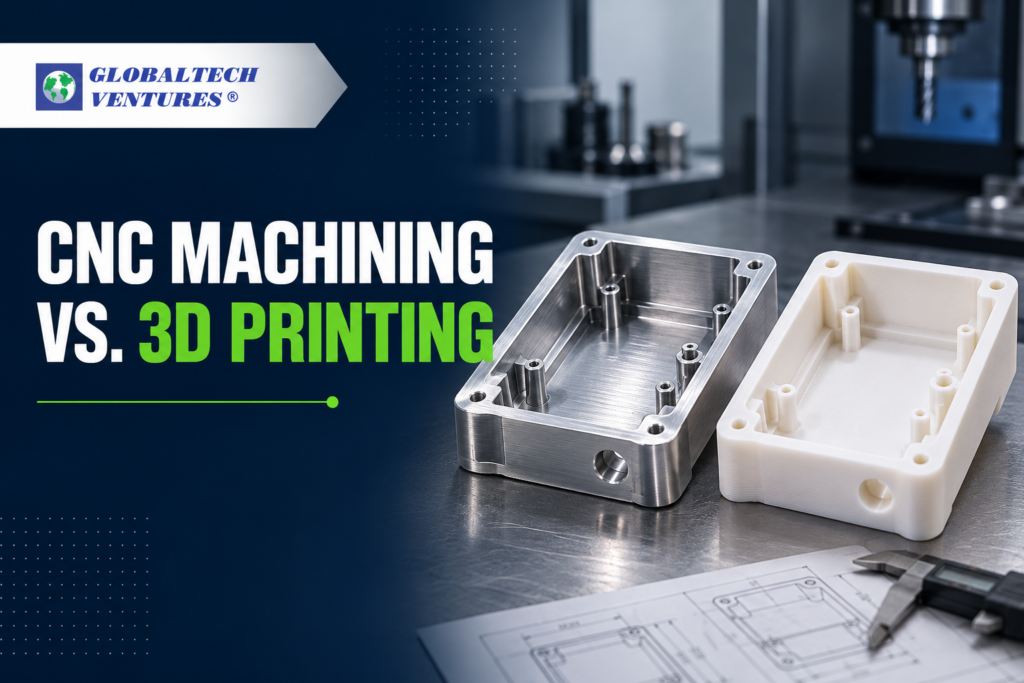
A functional prototype performs successfully. What does that result establish about the design, material, and manufacturing method?
CNC machining and 3D printing can both support functional evaluation. Their suitability depends on the geometry, material properties, accuracy, finish, and conditions the prototype must represent.
Global Technology Ventures Inc. (GTV) approaches prototyping within the broader Production Lifecycle. Start by matching the prototype method to the decision it must support, then define what the build needs to demonstrate.
Is CNC machining or 3D printing better for functional prototypes?
Both can be appropriate. Compare the required materials, geometry, interfaces, finish, and evaluation conditions. Choose the method that best represents the required characteristics. Confirm process limitations and any secondary operations before ordering.
Can a 3D-printed prototype provide meaningful functional results?
Yes, when the selected material, process, and configuration suit the evaluation. Define the conditions and acceptance criteria first. Interpret results within that scope, including differences between the printed component and any intended production version.
Start With the Validation Question
Identify the decision before choosing the process.
An assembly review may concern connector access or component alignment. A functional evaluation may examine movement, loading, or behavior under specified operating conditions.
Establish the relevant requirements, acceptance criteria, and evaluation responsibilities. Include appearance or demonstration requirements where they influence the build.
This brief helps determine which characteristics require close representation and which differences are acceptable.
What CNC-Machined Prototypes Can Help Evaluate
CNC machining can support evaluation of selected engineering materials, mating surfaces, critical dimensions, and functional interfaces.
In a hypothetical bracket program, a machined prototype could help investigate alignment and deflection under a defined load. Its measured geometry would provide context for interpreting the result.
Material selection, tool access, workholding, and finishing still require consideration. A machined component may differ from a later molded, cast, or formed version. Assess whether those differences affect the current evaluation.
What 3D-Printed Prototypes Can Help Evaluate
3D printing can support functional testing, assembly evaluation, packaging reviews, and design iteration when the process and material suit the requirements.
In a hypothetical enclosure program, a printed assembly could help evaluate connector engagement or operation of an internal mechanism.
Build orientation, material properties, dimensional accuracy, and post-processing can influence performance. These factors should inform the evaluation plan.
For appearance models or demonstrations, surface preparation and finish may also be important acceptance requirements.
Compare the Methods Against the Required Evidence
Compare the available processes against the same project requirements. Neither method has a universal advantage.
| Requirement | CNC machining considerations | 3D printing considerations |
|---|---|---|
| Functional performance | Selected stock material and finished features must suit the evaluation. | Printed material and build conditions must suit the evaluation. |
| Critical interfaces | Consider machining access, workholding, dimensions, and surface requirements. | Consider achievable accuracy and any finishing or secondary machining. |
| Material relevance | Assess differences between stock material and the intended production component. | Assess differences between printed properties and the intended production component. |
| Geometry | Cutting-tool access and setups can constrain features. | Build orientation and process-specific support requirements can constrain features. |
| Appearance | Specify visible surfaces and finishing requirements. | Specify visible surfaces and finishing requirements. |
| Production relevance | Identify differences from the intended manufacturing route. | Identify differences from the intended manufacturing route. |
Include inspection needs, timing, and revision requirements in the comparison. Confirm achievable results with the supplier before committing.
When Combining Both Methods Improves Validation
Different questions may justify different builds or a combination of processes.
A program might use printed geometry for packaging evaluation and machined features for a particular interface. Another may use additive manufacturing for its functional build.
A hybrid prototype may combine a printed body with machined mating features. Document its construction so results remain linked to the configuration evaluated.
Use multiple methods when each contributes useful information to the decision.
What Neither Method Establishes on Its Own
A successful prototype does not establish sustained manufacturing repeatability, and dimensional risks often surface only once production begins.
For programs progressing toward production, further work may be needed to evaluate tooling, process variation, assembly controls, or inspection methods.
Results also apply to the configuration evaluated. Findings from different revisions should not be combined without checking their applicability.
The required follow-up depends on the next commitment and the consequences of unresolved differences.
Make the Next Build Support a Specific Decision
Select an approach based on the question being investigated. Record relevant limitations and agree on evaluation activities, documentation, and approval responsibilities.
As the program progresses through the Production Lifecycle, carry forward findings that remain applicable. Identify which changes require further investigation.
This connects method selection with the next project milestone while keeping the scope clear.
Let’s Review Your Project Together
Bring the current geometry, candidate materials, critical interfaces, and intended evaluation conditions. Include quantity, timing, appearance requirements, and the planned production route where relevant.
Let’s Review Your Project Together to discuss a suitable build approach and clarify the support required.